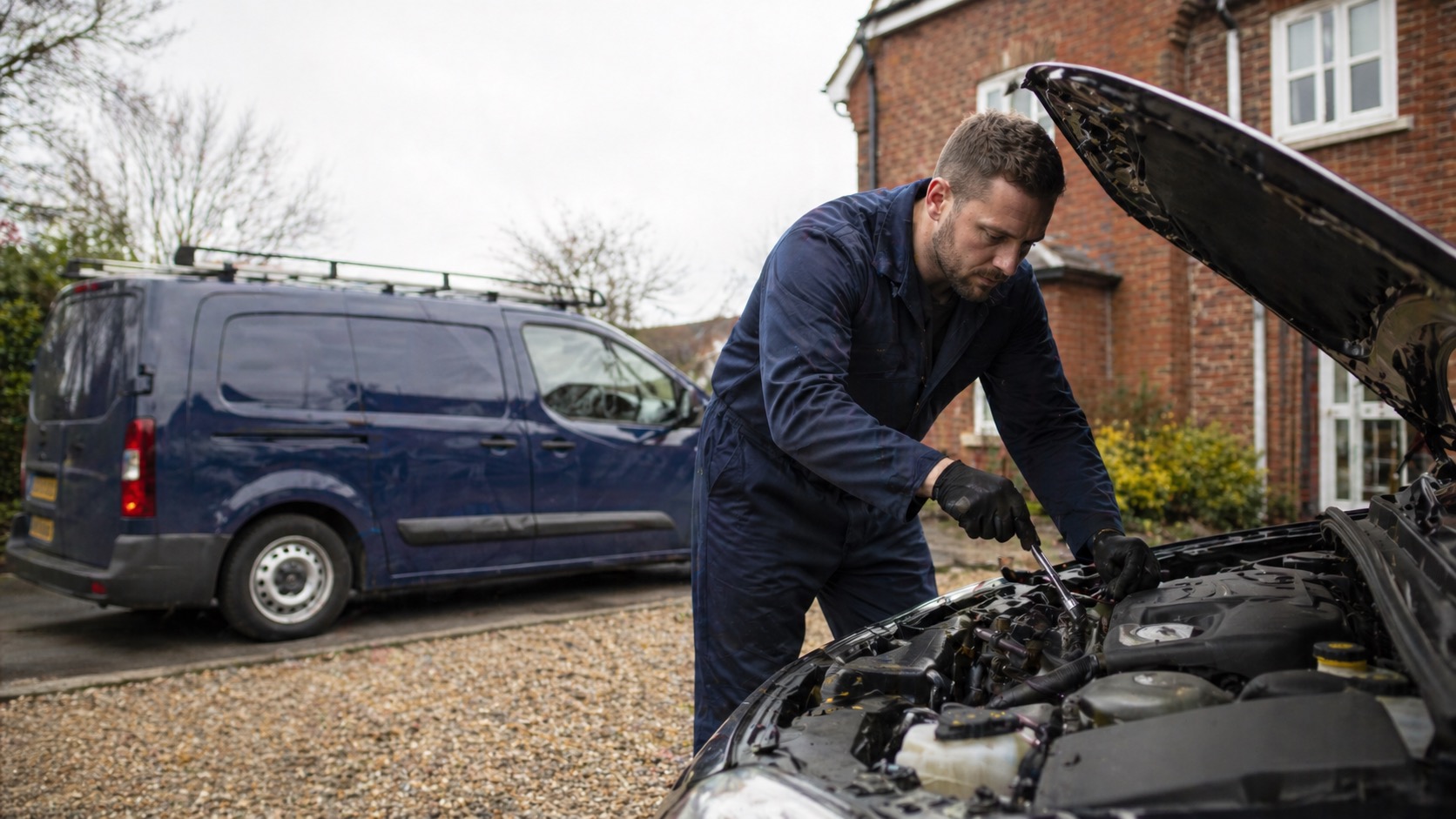
Mobile mechanics have a working environment that is, almost by definition, hostile to phone calls. You’re lying under someone’s car on their driveway. You’re elbow-deep in an engine bay in a supermarket car park. You’re torquing a wheel with an air gun that makes conversation impossible. The phone buzzes. You can’t get to it. By the time you can, whoever called has already moved on.
It’s a problem that every trade deals with to some degree, but mobile mechanics have it particularly bad — and particularly often. The nature of the work means you’re always on a job, always in an awkward position, and almost never near a desk.
The growth of mobile
Over the past few years, mobile mechanics have become one of the fastest-growing segments in automotive repair. The economics are straightforward: no garage rent, no business rates, lower overheads. Customers like it too — no drop-off, no waiting room, no rearranging their day. The car gets fixed wherever it is.
What’s driving this isn’t just cost. It’s convenience. People who work from home don’t want to lose a morning taking the car to a garage. Parents on the school run don’t want the hassle. Fleet managers want someone to turn up at the yard and deal with it on-site. The demand is there, and it’s growing.
But the same thing that makes mobile mechanics attractive to customers — they come to you — is what makes them hard to reach. A garage has a reception desk. A mobile mechanic has a phone in an oily pocket.
What happens to the missed calls
We looked at some of the forums where mobile mechanics talk shop — r/MechanicAdvice, local Facebook groups, trade forums — and the same complaint comes up over and over: “I’ll finish a job and find four missed calls. Two don’t answer when I ring back. One’s already booked someone else. I get through to one.”
That’s a 25% conversion rate on inbound enquiries, and it’s generous. For mobile mechanics working alone, the pattern is worse on busy days — the days when they’re already fully booked and calls are stacking up for future work.
The problem isn’t that people don’t want to use a mobile mechanic. It’s that people who call a mobile mechanic are usually in a specific situation — the car won’t start, there’s a warning light, they need an MOT-related fix before a deadline — and that situation has a short shelf life. If you don’t respond quickly, the problem either gets solved by someone else or the urgency fades and they put it off entirely.
One mechanic, one phone
The structural challenge is that most mobile mechanics are sole operators. There’s no team. There’s no office. There’s one person, one van, and one phone. Every call that comes in is either answered by the mechanic or it isn’t answered at all.
Some try workarounds — a partner who takes messages during the day, a Bluetooth earpiece they wear on the job, a voicemail greeting that promises a callback within two hours. These help at the margins. But a partner has their own life. Bluetooth doesn’t help when you’re using an impact wrench. And voicemail, as every trade already knows, barely gets used. The industry average is less than 3% of callers leaving a message.
The mechanics who are growing — taking on more work, expanding to a second van, building a reputation — tend to be the ones who’ve found a way to handle the first contact without being personally available. Whether that’s an automated answering system, a virtual receptionist, or something else, the principle is the same: the phone gets answered, the job details get captured, and the mechanic calls back when the job is done.
The driveway advantage
There’s an irony in all of this. Mobile mechanics already have one of the best propositions in the trades. They’re convenient. They’re usually cheaper. The customer doesn’t have to do anything except be at home. It’s a good product.
The gap is between how good the service is and how hard it is to book it. Close that gap — make the first contact as easy as the service itself — and the business grows. Leave it open, and you’re the mechanic with great reviews and a phone full of missed calls.