Dog grooming is, at its core, a relationship business. Clients trust you with an animal they love. They have preferences about the cut, the products, the handling. Nervous dogs need quieter slots. Puppies need shorter sessions. Elderly dogs need patience. That trust takes time to build, and once it’s established, clients tend to stay for years.
Which makes the phone situation particularly frustrating, because the thing that most often damages those relationships isn’t the grooming. It’s the scheduling.
Why does phone tag cost dog grooming businesses clients?
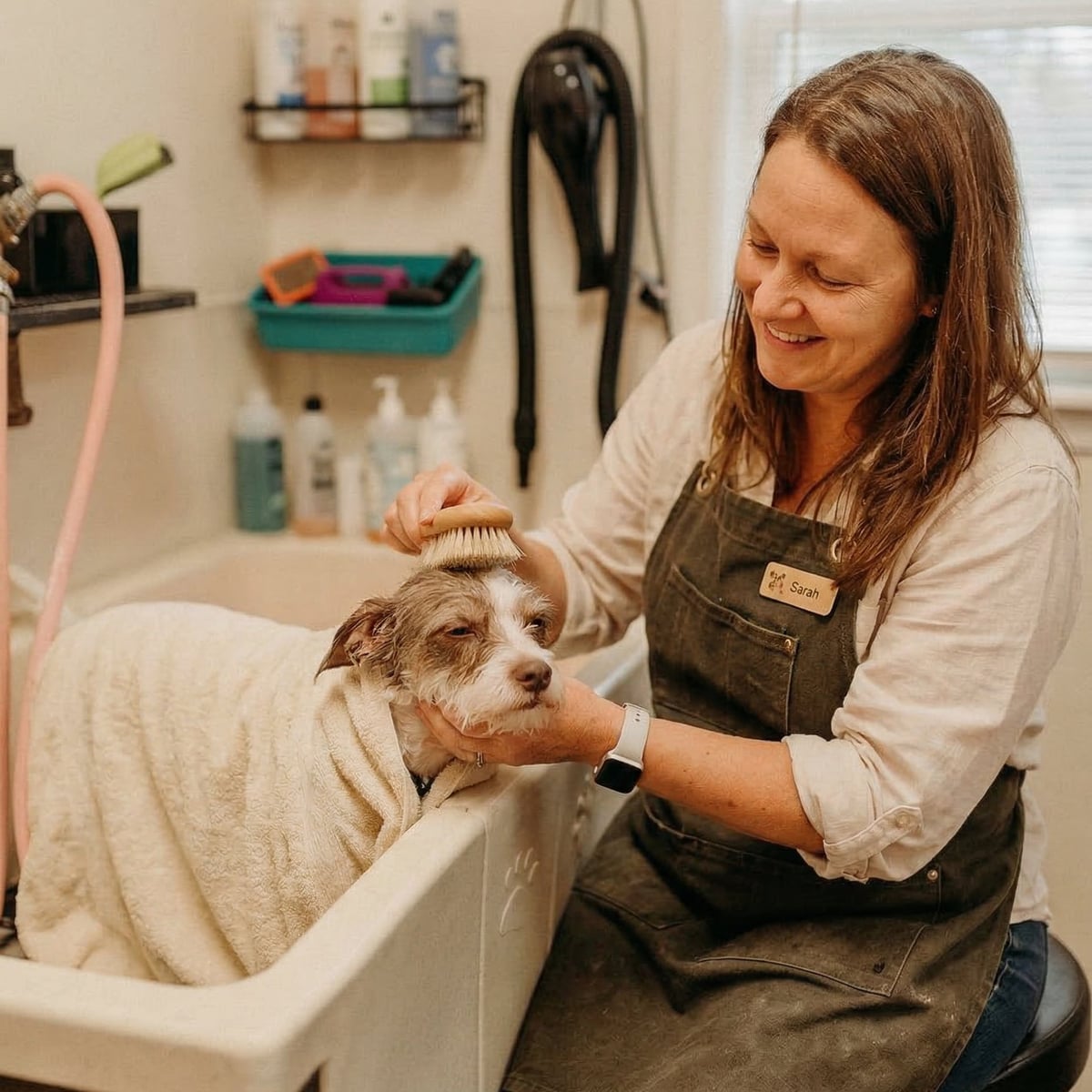
Most groomers work alone. They’re in a small space with a wet dog, a dryer running, scissors in hand. Taking a phone call in that situation is somewhere between impractical and unsafe. The dog needs constant supervision, the client is picking up in an hour, and the call is from someone wanting to book a cockapoo in for next Thursday.
The Pet Industry Federation reports that the UK grooming market has grown significantly in recent years, with the majority of grooming businesses being sole traders or very small operations. This means more demand hitting businesses with exactly one person available to answer the phone — and that person is usually holding a pair of thinning shears.
The result is phone tag. The groomer misses the call. Returns it at lunch. The client is at work and can’t answer. The client tries again at five. The groomer is doing a late appointment. By the time they connect, it might be the third or fourth attempt across two days. For a booking that would have taken ninety seconds if they’d spoken the first time.
Why does a missed call matter more for groomers than other trades?
In most trades, a missed call means a lost job. In grooming, a missed call from a new client could mean a lost relationship worth hundreds of pounds a year in repeat bookings. A regular client who books every six to eight weeks represents somewhere around £300-500 annually. Multiply that across even a few lost clients and the cost adds up quickly.
Existing clients who struggle to get through don’t usually complain. They just gradually drift towards a groomer who’s easier to book with. The business owner might not notice the churn for months, and by then the pattern is established: the client has a new regular groomer and isn’t coming back.
The scheduling itself is unusually complex for a sole-trader business. Different breeds require different slot lengths. A toy poodle is forty-five minutes. A large doodle might need two hours. A nervous dog needs extra time at the start to settle. The groomer can’t just book callers into the next available slot — they need to know the breed, the dog’s temperament, and what the owner wants done, then match that to the time available in their diary. This is a conversation, not a click.
What does good booking management look like for a groomer?
The grooming businesses that manage this well tend to have either a dedicated booking system that clients can use themselves, or a way of capturing enquiry details when they can’t answer so the callback can be focused and efficient.
A groomer we spoke to described her old routine: finish a dog, check the phone, see three missed calls, return them in a twenty-minute window before the next appointment arrived. “Half the time I’d get voicemails that just said ‘hi, it’s Sarah, can you call me back,’ and I’d have no idea which Sarah or what she needed.” Capturing the dog’s breed, the service wanted, and a couple of preferred times upfront means the return call takes thirty seconds instead of five minutes.
The underlying issue isn’t unique to grooming — it’s the same cost of answering your own phone that affects every sole trader. But the combination of working alone, having your hands literally full, and running a business built on relationships and repeat bookings makes the phone coordination problem especially punishing.