We asked a few dozen people — friends, family, a handful of strangers in a pub — the same question: what goes through your mind when you call a business and nobody answers?
The responses were remarkably consistent. Not angry. Not offended. Just quick to move on.
What does a customer assume when nobody answers?
Nearly everyone we asked said their first thought was that the business was either too small to have someone answering the phone, or too busy to care about new customers. Neither assumption is usually accurate, but both are damaging.
The “too small” reading makes people worry about reliability. If there’s nobody to pick up the phone, will there be anyone to come back and fix it if something goes wrong? The “too busy to care” reading is worse, because it suggests the business doesn’t need their work, which makes the caller feel like they’d be low priority even if they did get through.
One person put it bluntly: “If they can’t answer the phone, I assume the rest of the service will be the same.”
That’s unfair to the electrician who was working in a consumer unit, or the roofer who was three storeys up, or the cleaner who was in the middle of a job and physically couldn’t reach their phone. But the caller doesn’t know any of that. They just know nobody answered.
Voicemail makes it worse
Several people told us they’d leave a voicemail for a business they already had a relationship with — their usual plumber, their regular cleaner — but wouldn’t for a business they were calling for the first time. The reasoning was consistent: leaving a voicemail for a stranger feels like shouting into a void. There’s no indication anyone will listen, no sense of when you might hear back, and no confidence that the business is even still operating.
Invoca’s data backs this up at scale. Less than 3% of callers leave a voicemail when they reach one. That means voicemail isn’t functioning as a safety net for most businesses, even though most business owners assume it is.
What decision does a caller make in the first three seconds?
The thing that surprised us most was how fast the decision happens. Nobody described a careful evaluation process. It was more like: they called, nobody answered, they felt a flicker of doubt, and they called the next number. The whole thing took a few seconds.
By the time the business owner finishes their job and checks their phone, the customer has often already booked someone else. Not because that person was better or cheaper, but because they were first. The callback delay that follows a missed call is almost always too late, even when it’s only a few hours.
What makes a caller stay rather than call a competitor?
The businesses that handle this well tend to have one thing in common: when someone calls, something happens. Not voicemail. Not a recorded message. An interaction that makes the caller feel like they’ve been heard and that someone will follow up.
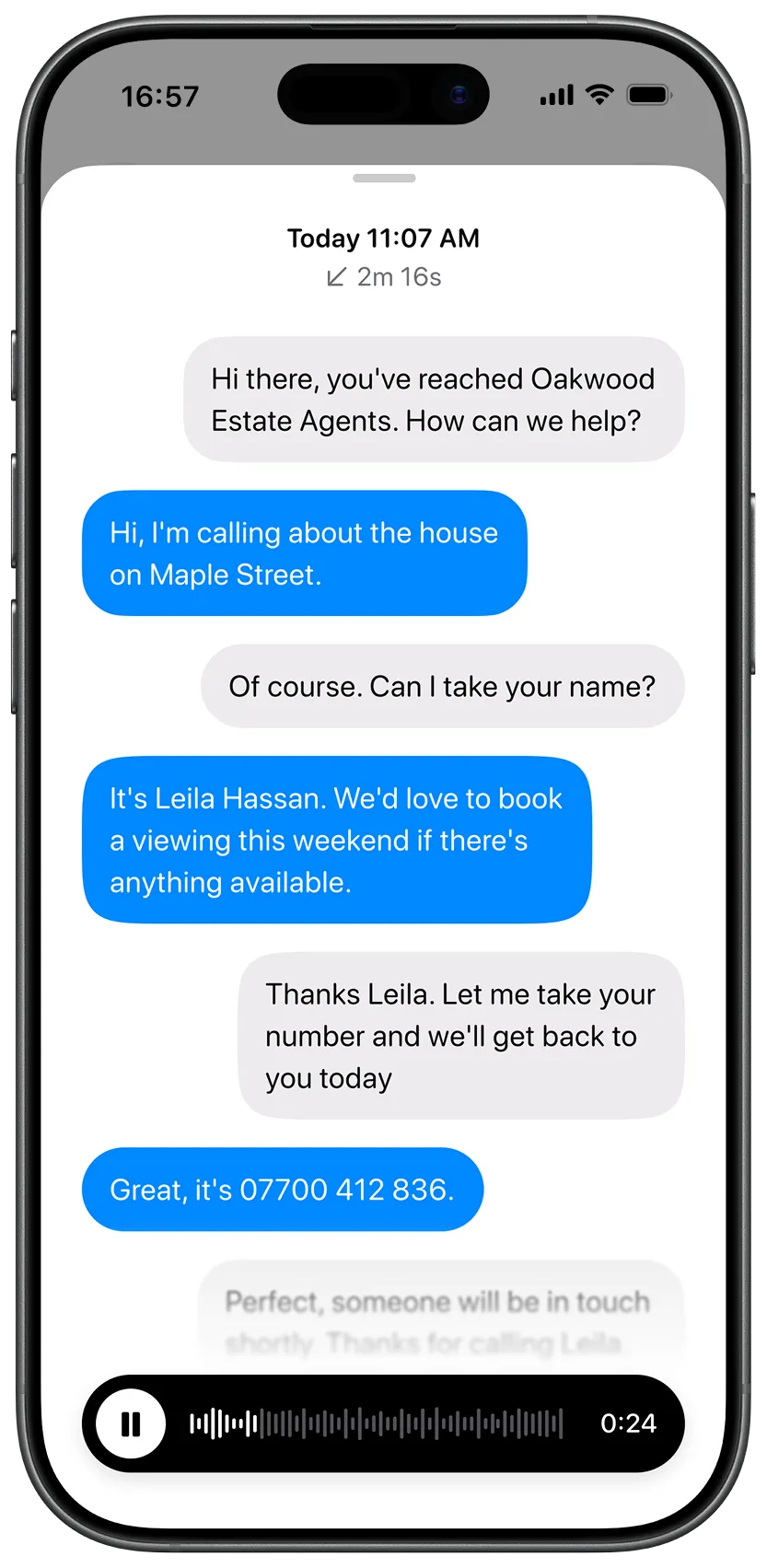
For some businesses that means having a partner or office person who picks up. For others it’s an AI receptionist that handles the conversation and captures the details. Brad, a mechanic we’ve spoken to, described the shift: callers used to get his voicemail and most of them hung up. Now they get a short conversation, give their details, and he follows up when the job’s done. The callers are the same people. The difference is that something engaged them before they had time to move on.
The missed call is only half the problem. The other half is what the customer concludes about your business in the few seconds after nobody picks up. That conclusion, fair or not, is usually what determines whether they try again or just call the next number on the list.